DN to NPS Pipe Size Chart [In MM & Inches] Explained

George Packard
Read Full Bio![DN to NPS Pipe Size Chart [In MM & Inches] Explained](https://www.geminivalve.com/wp-content/uploads/2021/09/DN-to-NPS-Pipe-Size-Chart-In-MM-Inches-Explained-800x385.png "DN to NPS Pipe Size Chart [In MM & Inches] Explained")
When selecting a valve, you need to know what pipe size is required for your application. Pipes are sized according to two measurement systems: DN (diametre nominal, in millimeters) and NPS (nominal pipe size, in inches). Since these are based on different standards, a DN-to-NPS conversion chart is essential for piping system design.
Download the DN to NPS Pipe Size Chart
- DN and NPS are nominal (trade) sizes, not exact measurements.
- DN is metric (ISO standard); NPS is imperial (ASME standard).
- A DN 25 pipe = NPS 1. A DN 50 pipe = NPS 2.
- Valve sizes correspond directly to pipe size; always confirm full port vs. standard port.
- Use a conversion chart to convert between DN and NPS before specifying components.
What Do DN and NPS Stand For?
DN stands for diametre nominal, the metric designation for a pipe’s nominal inside diameter, measured in millimeters (mm). NPS, or nominal pipe size, is the imperial equivalent, measured in inches. In documentation, neither abbreviation includes a unit suffix. For example, you’ll see DN 20 or NPS ¾, but never “DN 20mm.”
DN measurements conform to ISO (International Organization for Standardization) standards and apply to plumbing, natural gas, heating oil and general piping. NPS is governed by ASME (American Society of Mechanical Engineers) standards and is used for pipes, valves, fittings and related components in the United States and other markets that use imperial measurements.
Note: NPS is sometimes confused with “National Pipe Straight” (also NPS), which refers to pipe thread structure. These are separate standards.
DN to NPS Pipe Size Chart
Use the following table to convert between DN (mm) and NPS (inches). This chart covers the most common nominal pipe sizes used in industrial, commercial and plumbing applications.
Nominal Pipe Size (NPS) Conversion
| DN (mm) | NPS (inches) |
|---|---|
| DN 10 | 3/8″ |
| DN 15 | 1/2″ |
| DN 20 | 3/4″ |
| DN 25 | 1″ |
| DN 32 | 1-1/4″ |
| DN 40 | 1-1/2″ |
| DN 50 | 2″ |
| – | 2-1/2″ |
| DN 65 | – |
| DN 80 | 3″ |
| DN 100 | 4″ |
| DN 125 | – |
| – | 5″ |
| DN 150 | 6″ |
| DN 200 | 8″ |
| DN 250 | 10″ |
| DN 300 | 12″ |
| DN 350 | 14″ |
| DN 400 | 16″ |
| DN 450 | 18″ |
| DN 500 | 20″ |
| DN 600 | 24″ |
| DN 700 | 28″ |
| DN 800 | 32″ |
| DN 900 | 36″ |
| DN 1000 | 40″ |
| DN 1200 | 48″ |
Pipe Schedule Size Calculator (in.)
Not sure of your pipe’s size? Use the calculator to determine the correct DN or NPS classification before ordering valves or fittings.
How Are Pipe Sizes Measured?
Pipe sizes are nominal, meaning the labeled size does not exactly match the physical diameter. For example, a pipe with a NPS 3 classification might actually have an inside diameter measuring 3 ⅝”. This standardization simplifies ordering and specification across manufacturers.
If a pipe is unmarked, or you’re not sure of its size, you can determine this using some simple tools.
To measure a male pipe fitting, you’ll need a piece of string, a ruler and a calculator.
- Wrap the string around the pipe and mark the point of contact.
- Using the ruler, straighten the string and measure from the end of the string to the point of contact.
- Divide this measurement by 3.14159 ().
- Consult a pipe sizing chart to determine the nearest DN or NPS value.
Finding the size of a female pipe fitting is much simpler, and only requires a ruler and a calculator.
- Measure the inside diameter of the pipe across the opening.
- Consult a pipe sizing chart to determine the nearest DN or NPS value.
How to Choose the Right Valve
Once you know the size classification of your pipes, you will know which size valves you might need. Valve sizes directly correlate to the diameter of the pipe in which they are placed. However, there are two different size classifications for valves.
Full port (or full bore) valves have a port, or hole, whose diameter matches that of the pipe it’s in. For example, a 1 ¼” full port ball valve is meant for a NPS 1 ¼ pipe.
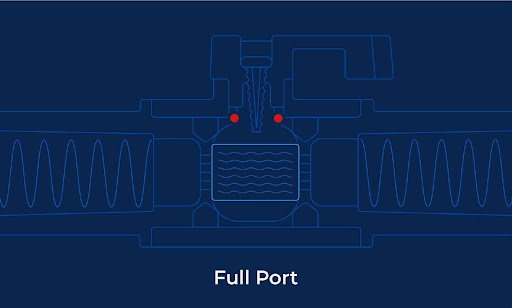 |
Full port valves have low flow resistance and therefore can act as just another stretch of pipe when fully open. When fully open, a full port valve will cause little to no pressure drop, which is the difference in media pressure on either side of the valve. Full port valves are required for applications in which flow rate and pressure drop are critical considerations and are especially preferred for more viscous media. They are the best choice for isolating media in a piping system and most allow for two-way flow. |
| Since standard port valves have holes that are slightly narrower than the pipes they’re in, they offer a bit more resistance to media flowing through the valve. In a fully open position, standard port valves will cause a pressure drop. Standard port valves are the default choice for most applications and easy-flowing media, especially if space is limited, and are more economical than full port valves.
Although standard port valves do restrict flow, valve port sizes are not typically a major cause of bottleneck in a piping system; rather, flow rate is usually dictated by the length of a pipe and the number of bends in the piping system. |
 |
If you have any questions about pipe sizing, or need guidance in choosing the right ball valve size for your application, the team at Gemini Valve is happy to help. Send us a note today, and we’ll be in touch soon.
Frequently Asked Questions (FAQ)
What is DN in pipe size?
DN stands for diametre nominal, the ISO metric designation for a pipe’s nominal (approximate) inside diameter, expressed in millimeters. It is the metric equivalent of nominal pipe size (NPS) and is used internationally.
What is the difference between DN and NPS?
DN and NPS both describe the same physical pipe sizes, but in different unit systems. DN uses millimeters and follows ISO standards; NPS uses inches and follows ASME standards. Neither value reflects the exact physical diameter; both are nominal trade names. For example, DN 25 = NPS 1, but a physical pipe labeled either way may have an actual inside diameter closer to 1⅛”.
How do I convert DN to inches?
Use a DN to NPS chart to find the corresponding NPS value, then refer to a standard pipe OD table for the actual inch dimension. As a quick reference: DN 25 ≈ NPS 1, DN 50 ≈ NPS 2, DN 100 ≈ NPS 4, DN 150 ≈ NPS 6.
What does NPS stand for in piping?
NPS stands for nominal pipe size, the ASME imperial standard for measuring pipes, valves and fittings in inches. It should not be confused with National Pipe Straight (also abbreviated NPS), which is a separate standard governing pipe thread form and geometry.
What are typical pipe sizes used in industry?
The most common nominal pipe sizes in industrial and commercial applications include NPS ½, ¾, 1, 1¼, 1½, 2, 3, 4, 6, 8, 10 and 12 (DN 15 through DN 300). Larger diameters (DN 350 to DN 1200) are used in water distribution, oil and gas transmission and large HVAC systems.
George Packard
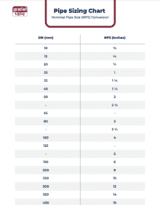
DN to NPS Pipe Size Chart [In MM & Inches] Resource
This chart will help you convert your measurements to the correct pipe size.