What to Look For in a Pneumatic Actuator Ball Valve Manufacturer

George Packard
Read Full Bio
A pneumatic actuated ball valve is where your control system meets your process. When the valve cycles on command and moves to a safe position after a loss of air, your line keeps running. When it doesn’t, you’re facing downtime and possibly a safety incident. How reliably a valve performs depends heavily on its manufacturer.
This guide covers what separates the top pneumatic actuator ball valve manufacturers from commodity suppliers and why Gemini Valve ranks among the best pneumatic actuator ball valve suppliers in the USA.
(If you’re still weighing your actuation options, start with our comparison of pneumatically vs. electrically actuated ball valves or our overview of types of valve actuators.)
What Is a Pneumatic Actuated Ball Valve?
A pneumatic actuated ball valve is a ball valve with a pneumatic actuator mounted on top. The actuator turns compressed air into rotary motion, rotating the ball a quarter turn to open or close flow. A solenoid valve typically controls the air supply, so a signal from a PLC or control panel can operate the valve remotely without anyone on site.
Pneumatic actuators come in two main types:
- Double-acting actuators use air pressure to both open and close the valve. They suit high-cycle applications.
- Spring-return actuators use air to open the valve and an internal spring to close it. If air or power fails, the spring drives the valve to the fail-safe position.
Two-way valves handle simple on/off service. A 3-way ball valve with a pneumatic actuator can divert flow between lines or select between sources. Pneumatic actuation is a common choice for high-cycle automation thanks to its speed, simplicity and tolerance of harsh environments.
What to Look for in a Pneumatic Actuator Ball Valve Manufacturer
A pneumatic actuated ball valve pairs two components that have to work as one. When you compare pneumatic actuator ball valve suppliers, look past the spec sheet to how each manufacturer builds and supports the full assembly.
Experience with actuated assemblies
Plenty of companies just make ball valves, and plenty just make actuators. Fewer design both to work together. A manufacturer with a long track record in automated valves understands how actuator design affects seal life and cycle performance in real applications.
→ Ask how long a supplier has built actuated assemblies and if it designs its own actuators or sources them from a third party.
Responsive application support
There are some decisions a catalog can’t make for you, like fail-closed operation or the right solenoid for your control system. Look for a supplier whose engineers will talk through your application before you order and answer technical questions after installation.
→ Ask about serviceability, too. A manufacturer that lets you replace worn components saves you from buying a new assembly every time one part wears out.
Configuration breadth
The right manufacturer offers the configurations your system needs without forcing workarounds. Look for double-acting actuators for high-cycle service and spring-return actuators for fail-safe operation. Some manufacturers also offer hybrid designs that pair double-acting service life with a spring-return fail-safe. Body materials should match your media, such as brass for general service or 316 stainless steel for corrosive and sanitary applications. Check that solenoid valves and limit switches mount directly to the actuator, ideally through a standard NAMUR interface.
Quality control and testing
Look for a manufacturer that leak-tests and functionally tests 100% of its assemblies before shipment, not a sample from each batch. Leak testing confirms the seals hold under pressure. Functional testing cycles the actuator to confirm the valve opens, closes and returns to its fail-safe position as specified. Together, they catch defects at the factory instead of on your line.
→ Ask whether every assembly is leak-tested and cycle-tested, and whether that testing happens in-house.
Certifications
Certifications show that products have been independently verified against recognized standards. For food and beverage equipment, look for NSF certification. UL and NEMA compliance signals that products meet established safety and enclosure standards for industrial environments.
Delivery and lead times
A manufacturer that machines its own major components controls its supply chain and is less exposed to outside shortages.
→Ask how quickly a supplier responds to quote requests and how it handles expedited orders. Assemblies that arrive ready to install also save time on site.
USA-made, factory-direct support
Some pneumatic valve packages sold in the U.S. pair an imported valve with an actuator mounted by a distributor. A domestic manufacturer that designs and builds both in-house gives you clearer traceability and support from the people who built the product. Buying factory-direct also removes reseller markups, and your technical questions go straight to the engineering team.
Why Gemini Valve Is a Leading Pneumatic Actuator Ball Valve Manufacturer
Gemini Valve is one of the leading manufacturers of pneumatic actuator ball valves in the U.S., specializing in automated ball valves from ¼” through 2″ for OEM equipment and industrial systems. The family-owned company traces its roots to 1917, and has built valves under the Gemini name since 1974.
The Original Direct-Mount Pneumatic Actuator
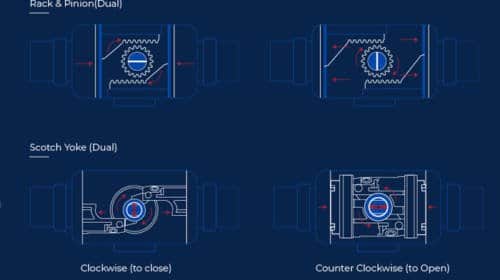
In 1975, Gemini introduced the industry’s first direct-mount rack-and-pinion pneumatic actuator. The patented design gave the valve and actuator the rigidity and alignment needed for long seal life, all in an ultra-compact footprint. Gemini has refined that design ever since. In 2017, it produced a record 100,000+ actuated ball valves in a single year.
Fail-Safe Options for High-Cycle Service
Gemini’s pneumatic lineup includes double-acting models for high-cycle performance and spring-return models that fail closed when air or power is lost. For applications that need both, Gemini developed an industry-first double-acting actuator with spring-return modules. It delivers the service life of a double-acting design and still fails closed if air or power drops out. Cycle times on the Performance Automation Series run ½ to 1 second.
Built and Tested Under One Roof
Every Gemini pneumatic actuated ball valve is designed, machined, assembled and tested in its 60,000-square-foot facility in Raymond, New Hampshire. Gemini makes its major components in-house for consistent supply and tests 100% of its pneumatic valves before they ship. Gemini also offers products that meet specific UL and NEMA standards, and many valves carry NSF certification for use in food and beverage equipment.
Direct Access to Engineers
Buying factory-direct from Gemini means no reseller markups and no middleman between you and the team that built your valve. Weekday technical support is available, and most quote requests get a response within one business hour. When a valve wears out, the ball valve can typically be replaced on its own without buying a new assembly.
Trusted by OEMs
Gemini has a 40-year track record of working with OEMs to adapt its products for custom applications, from compact form factors to fail-safe configurations.
| “Gemini Valve is a supplier I’ve been personally working with for the past 7 years. They have great customer service and an outstanding engineering support team that has assisted me with improving the performance of their valves in Henny Penny’s products.”
Ming Han |
| “We have used Gemini Valve products for 21 years, in the assembly of our Admixture Dispensing Equipment. The product quality is unsurpassed by any other. The sales and support staff are always friendly and helpful.”
Gary Smith |
Browse Gemini’s full line of pneumatic actuated ball valves today to find the right configuration for your system.
George Packard